
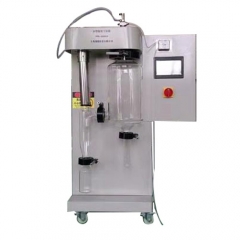
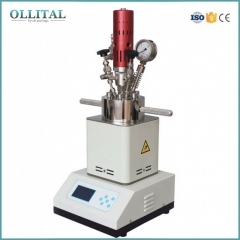
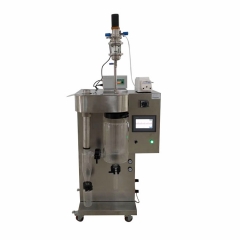
High quality 1.5L scale lab spray dryer equipment
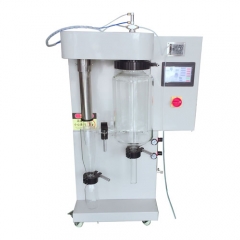
Lab scale spray dryer is suitable for the production of in universities, research institutes and food and pharmaceutical chemical enterprises.
A practical guide to contamination removal, surface activation, and process selection
A component can look clean and still be unsuitable for bonding, coating, printing, or assembly. Fine particles, machining oil, organic films, and residues may remain in recesses or form a thin layer that is difficult to see. In precision manufacturing, the question is therefore not simply how to wash a part, but what kind of surface condition the next process requires.
Ultrasonic cleaning and plasma cleaning are both used for surface preparation, but they work in different ways. Ultrasonic cleaning uses acoustic energy in a liquid to help detach contaminants. Plasma cleaning exposes a surface to energetic and reactive gas species that can remove certain residues and change surface chemistry. The right choice depends on the contaminant, the substrate, the part geometry, and whether the next operation needs only cleanliness or also improved wettability and adhesion.
The most useful starting point is to define the result you need. If a part must be free of loose debris, oils, or particles across complex geometry, a properly developed ultrasonic process may be appropriate. If the critical issue is a thin organic film or low surface energy before bonding, coating, printing, or another interface-sensitive step, plasma treatment may be the more direct option. In some production routes, the two methods are complementary rather than competing.
An ultrasonic cleaning machine converts electrical energy into mechanical vibration through transducers coupled to a cleaning tank. The vibration produces alternating pressure waves in the liquid. Under suitable conditions, tiny cavitation bubbles form, grow, and collapse. Their local mechanical effects help loosen contamination from the part, while the cleaning liquid helps dissolve, emulsify, or carry away the material that has been detached.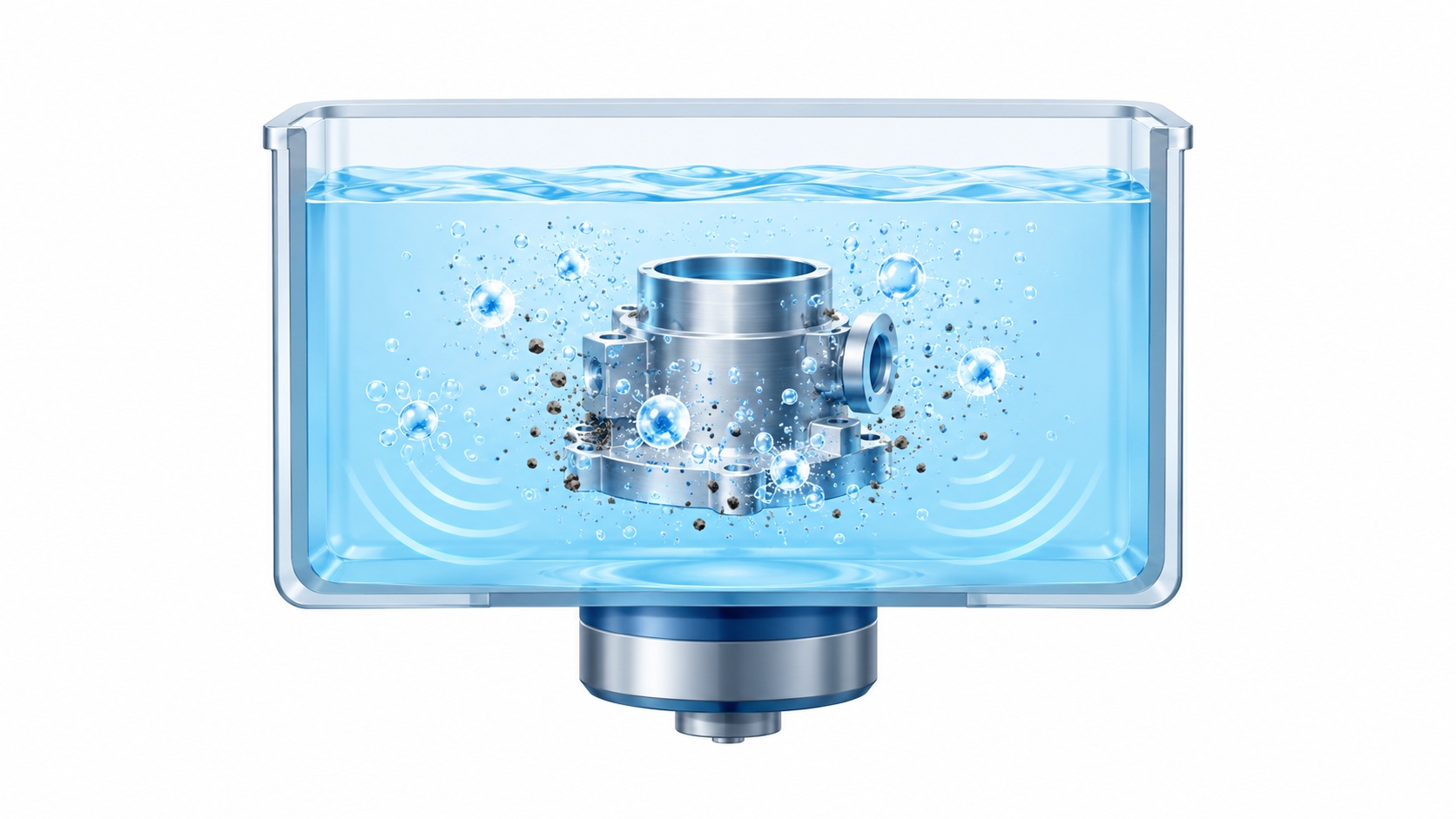
Figure 1. Simplified illustration of cavitation-assisted cleaning in a liquid bath.
This combination is important. Ultrasound is not a universal substitute for chemistry: the bath formulation, concentration, temperature, exposure time, loading pattern, and rinsing procedure all affect the outcome. A detergent suitable for water-soluble residues may not be the best choice for a heavy oil, and a solvent-based process raises its own compatibility, ventilation, and safety questions. Parts must also be arranged so that the liquid reaches the surfaces that need cleaning.
Ultrasonic cleaning is often attractive when parts have grooves, holes, narrow passages, or irregular surfaces that are difficult to scrub manually. It can be used for metal components, selected glass or ceramic parts, precision hardware, and other compatible workpieces. However, the word “ultrasonic” does not guarantee that every cavity is cleaned equally. Basket arrangement, part-to-part contact, trapped air, shadowing, and inactive zones in a tank can all reduce effectiveness.
The mechanical energy also needs to be matched to the part. ASTM’s practice for ultrasonic cleaning notes that cleaning performance varies with equipment frequency and power density, and warns that some low-frequency conditions can damage soft metals such as aluminum and silver. Delicate coatings, fragile structures, bonded assemblies, or components with microfeatures should therefore be tested rather than assumed safe.
Plasma is an energized gas containing a mixture of electrons, ions, radicals, excited species, and neutral molecules. In a plasma cleaner, an electrical discharge activates the process gas; the resulting species interact with the exposed surface. Depending on the gas chemistry and equipment design, these interactions can break down or remove certain organic residues, alter surface functional groups, and change how readily a liquid spreads across the material.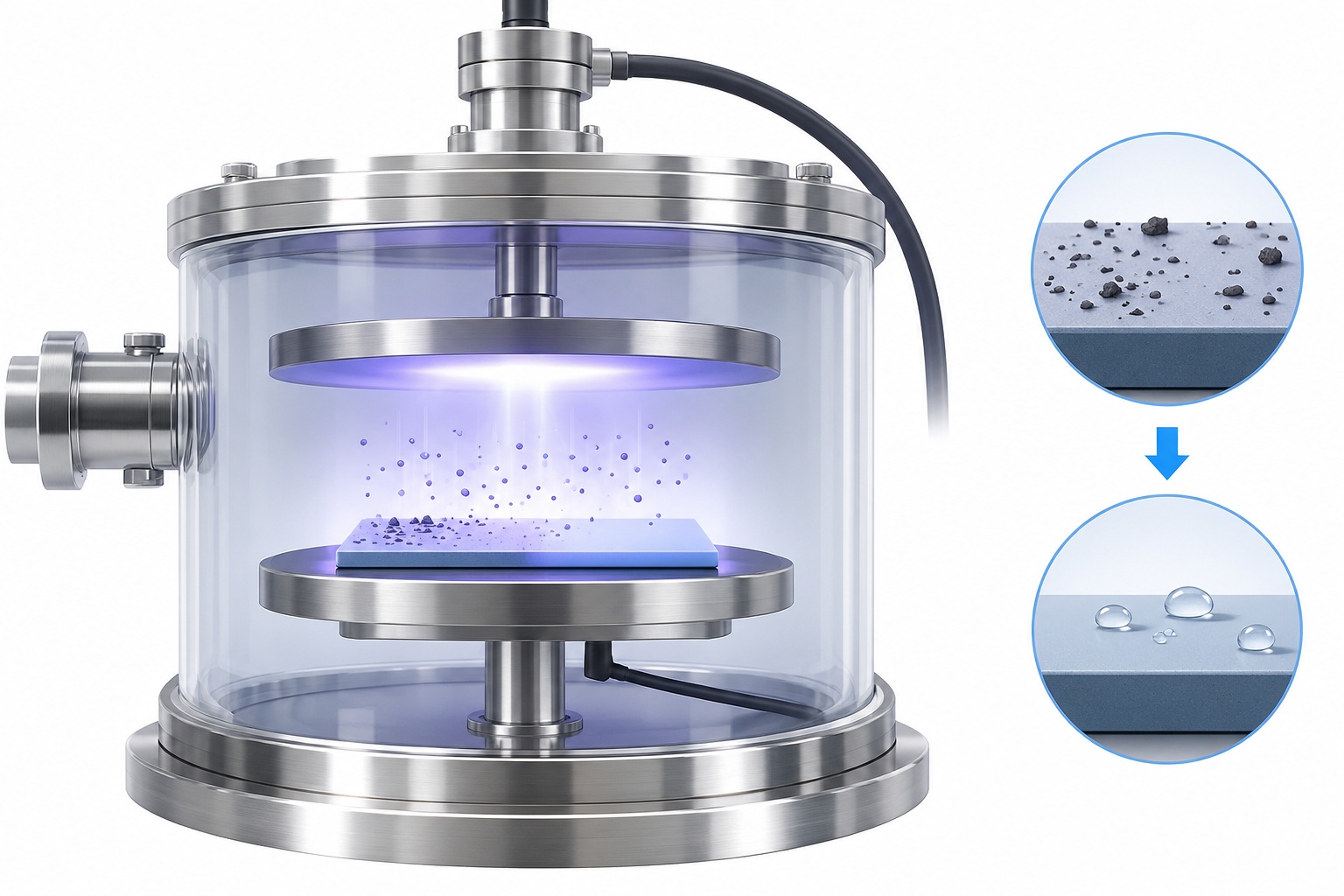
Figure 2. Conceptual view of plasma interacting with a surface and changing its wettability.
For example, oxygen-containing plasma is commonly used to remove organic contamination and introduce oxygen-containing functional groups on some surfaces. Argon plasma is chemically inert and can be useful for physical activation or surface modification, although it is generally less effective than oxygen plasma at breaking down organic material on its own. The exact result depends on the substrate, gas, power, pressure, exposure time, and chamber configuration.
Plasma treatment is particularly relevant when a surface must be prepared for adhesive bonding, coating, printing, lamination, or other processes where plasma surface treatment improves surfaceenergy and interfacial chemistry performance. It can treat a surface without immersing the component in a cleaning bath, and some plasma systems can process small or delicate samples under controlled conditions. Vacuum plasma systems and atmospheric-pressure systems are not interchangeable, however: they differ in equipment layout, process environment, treatment area, and the way parts are presented to the plasma.
Plasma is not a magic eraser for all contamination. Heavy grease, thick deposits, particles, salts, and residues that are not effectively removed by the selected gas chemistry may require another cleaning step first. A part can also be damaged or altered by an overly aggressive recipe. Gas selection, process compatibility, and the intended final surface properties should be verified on representative samples.
The practical distinction is not that ultrasonic cleaning removes dirt while plasma cleaning only activates surfaces. Both can contribute to cleaning, and both require process development. The difference is the main mechanism and the type of result each process is best positioned to deliver.
| Selection factor | Ultrasonic cleaning | Plasma cleaning |
|---|---|---|
| Primary mechanism | Cavitation and liquid-phase cleaning chemistry | Reactive and energetic gas species interact with the surface |
| Typical strength | Detaching particles and residues from wetted surfaces | Removing selected thin organic residues and modifying surface chemistry |
| Process medium | Liquid bath; often by rinsing and drying | Activated gas; vacuum or atmospheric-pressure systems depending on design |
| Complex geometry | Useful when liquid can reach recesses; trapped air and loading can limit results | Depends on plasma access, chamber geometry, and whether the surface is exposed to the active zone |
| Surface activation | Not usually the main objective | Can improve wettability and adhesion when the recipe and substrate are suitable |
| Main process risks | Liquid compatibility, residue after rinsing, cavitation-related damage | Recipe-dependent surface alteration, uneven exposure, gas and equipment safety requirements |
| Typical downstream need | A clean part ready for rinsing, drying, inspection, or assembly | A prepared interface for bonding, coating, printing, or related processes |
Use this comparison as a first filter, not as a substitute for trials. For example, a machined metal part with oil inside recesses may need liquid cleaning and rinsing before any further treatment. A polymer part that is visibly clean but difficult to bond may benefit more from plasma activation. A semiconductor, optical, or medical component may have requirements that demand a validated, documented cleaning process rather than a general-purpose rule of thumb.
The main problem is removable contamination such as machining oil, grease, polishing residue, or particles. An industrial ultrasonic cleaner works well here provided the part is compatible with the chosen liquid.
The component has recesses, threaded areas, narrow channels, or irregular surfaces that are difficult to clean manually, provided the liquid can reach them.
You can control the complete wet process, including bath chemistry, loading, rinsing, drying, and waste handling.
You need a repeatable batch process for many small parts and can validate that the tank delivers consistent cleaning throughout the load.
The surface is already relatively clean, but a thin organic film or low surface energy is undermining adhesion, coating, printing, or bonding.
You want to alter surface wettability or chemistry as part of a defined downstream process.
Avoiding a liquid immersion step is important for the part or process, and the chosen plasma system can expose the required surfaces.
You can control gas selection, treatment time, pressure or flow, part placement, and the delay between treatment and the next process.
Applications should be evaluated at the level of the actual material and contaminant, not only by industry label. For example, “electronics” may mean removing flux and particulate contamination from a board, cleaning a sensor housing, or activating a polymer before bonding. Those are different process problems. Likewise, a “plastic component” may tolerate one plasma recipe but be altered by another, and its response can vary with polymer formulation, additives, fillers, and surface finish.
Yes. A two-step process can be useful when bulk contamination must be removed before the surface is activated. Ultrasonic cleaning may first loosen oils and particles in a compatible liquid, by rinsing and thorough drying. Plasma treatment can then address residual organic contamination or improve the surface condition before bonding or coating. This sequence is only a starting hypothesis: the process order, rinse quality, drying conditions, and time between plasma treatment and the next operation must be validated for the specific material.
The sequence should not be chosen simply because two technologies are available. If ultrasonic cleaning leaves detergent residue, poor rinsing can undermine a later bonding process. If a part is recontaminated by handling after plasma treatment, the surface benefit may be reduced. And if the initial contamination is heavy or chemically incompatible with the plasma process, plasma alone may be an inefficient way to address it. Establish a measurable acceptance criterion for each stage so that the combination solves a defined problem.
Before comparing machine size, power, or price, prepare a short process brief. It should describe the component, the contamination, the required final condition, and the next manufacturing step. The following questions make equipment discussions more productive:
Substrate: What material, coating, plating, adhesive, or surface finish is present? Could cleaning energy or process chemistry damage it?
Contaminant: Is it particulate, oily, ionic, organic, oxidized, or a mixture? Is it a loose deposit or a thin film?
Geometry: Are there blind holes, narrow channels, stacked parts, shadowed areas, or surfaces that cannot be exposed directly?
Acceptance criteria: Will cleanliness be checked by visual inspection, particle counts, residue analysis, contact angle, adhesion testing, or another method?
Throughput: What is the batch size, cycle time, loading arrangement, and required repeatability?
Process environment: Are liquid waste, rinsing, drying, gas supply, vacuum, ventilation, or safety controls required?
Downstream timing: How soon after cleaning or plasma treatment must the part be bonded, coated, printed, or assembled?
These questions are especially important when the result is defined by a downstream operation. A part that looks clean may still fail an adhesion test, while a surface with improved wettability is not automatically free of particles or ionic contamination. Visual appearance alone is rarely enough to qualify a critical process.
A reliable surface-preparation process needs an acceptance test that reflects the job. For ultrasonic cleaning, this may mean checking residual oil, particle levels, ionic contamination, or the consistency of the rinse and drying stages. For plasma treatment, a contact-angle or wettability check may help indicate whether the surface has changed, but it does not prove that all contaminants have been removed or that a bond will meet its strength requirement. Where adhesion is the final objective, test the actual bonding or coating operation as well.
The test method should also match the material and production risk. A simple visual check can identify obvious residue but may miss a thin film. A water-break or contact-angle test can be useful for some surfaces, but it may not be suitable for every substrate or quality system. Critical applications may require residue analysis, particle measurements, or a defined performance test. Record the process conditions alongside the result so that a successful trial can be reproduced.
It is also worth checking process stability over time. Ultrasonic baths can accumulate contamination and lose performance if the solution is not maintained; loading patterns and bath condition can change the result. Plasma outcomes can vary with gas supply, chamber cleanliness, electrode condition, sample placement, and the interval before the next manufacturing step. A small, controlled trial by repeat runs is more informative than a single successful sample.
For applications where liquid-phase cleaning is the primary requirement, review the intended part size, basket or fixture arrangement, liquid chemistry, and process stages before selecting an ultrasonic system. Ollital’s ultrasonic cleaning equipment page provides an example of a tank-based machine and its cavitation cleaning principle. The right configuration still depends on the actual component and cleanliness target.
For surface activation or treatment of selected residues before bonding, coating, or related processes, a plasma cleaner for surface activation may be more appropriate. Ollital offers a laboratory vacuum plasma cleaner, and its plasma cleaner category covers additional equipment types. Vacuum chamber systems, atmospheric plasma equipment, and wider-area treatment systems serve different production situations; they should not be compared only by nominal power or chamber size.
When requesting a recommendation, provide a representative sample or clear photos, the material and contaminant details, the required process result, the part dimensions, and the target throughput. If the part must be bonded or coated after cleaning, include that downstream requirement. This helps determine whether the priority is liquid cleaning, surface activation, a staged process, or a test before equipment selection.
Neither method is universally better. Ultrasonic cleaning is often preferred for removing oils, particles, and residues from surfaces that can be reached by a cleaning liquid. Plasma cleaning is often more suitable when the goal is to remove selected thin organic residues or modify surface chemistry before bonding, coating, or printing. The right choice depends on the contamination and the required surface condition.
Not in every application. Plasma cleaning may not efficiently remove heavy grease, thick deposits, salts, or particles that require liquid-phase cleaning. When bulk contamination must be removed before surface activation, ultrasonic cleaning by rinsing, drying, and plasma treatment may be a more appropriate process.
The choice depends on the contaminant, surface finish, and part geometry. Ultrasonic cleaning can help remove machining oil and particles from compatible metal components, including parts with grooves and narrow passages. Plasma cleaning may be useful when a thin organic film or surface condition affects a subsequent bonding or coating process. Delicate surfaces should be tested before selecting either method.
It can, provided the cleaning liquid reaches the contaminated areas and the process conditions are suitable. Trapped air, part-to-part contact, poor basket arrangement, and inactive zones in the tank can reduce cleaning effectiveness. Complex geometry should therefore be evaluated under the intended loading and cleaning conditions.
Plasma treatment can improve wettability and modify surface chemistry, which may support adhesion on suitable materials. However, improved wettability does not automatically guarantee sufficient bond strength. The actual bonding or coating process should be tested to confirm that the required performance is achieved.
The choice depends on the substrate and treatment objective. Oxygen-containing plasma is commonly used to remove certain organic contamination and introduce oxygen-containing functional groups on some surfaces. Argon is chemically inert and can support physical activation or surface modification. Neither gas is the best choice for every material or process.
Yes, under certain conditions. Ultrasonic cleaning performance and material risk depend on factors such as frequency, power density, cleaning chemistry, and component structure. Some low-frequency conditions can damage soft metals such as aluminum and silver. Representative testing is advisable for delicate coatings, fragile structures, and sensitive assemblies.
Yes. Ultrasonic cleaning can first remove bulk contamination, by rinsing and thorough drying. Plasma treatment can then be used to modify the surface before bonding, coating, or printing. The sequence must be validated because detergent residue, recontamination, and delays after plasma treatment can affect the final result.
The test should reflect the required outcome. Ultrasonic cleaning may be evaluated through residual-contamination analysis, particle measurements, or checks of rinsing and drying performance. Plasma treatment may be assessed through contact-angle or wettability measurements, but these do not prove complete cleanliness or adequate adhesion. For critical applications, test the actual downstream process.
Start by identifying the substrate, contaminant, part geometry, required surface condition, and next manufacturing step. Then consider batch size, throughput, process compatibility, and safety requirements. If the goal is bulk contamination removal, evaluate an ultrasonic cleaning process. If the main requirement is surface activation or removal of selected thin organic residues, evaluate plasma treatment. For uncertain applications, test representative samples before finalizing the equipment configuration.



 Интернет Сервис
 +86 15960821529
 kevin@ollital.comkevinollital@gmail.com
 +86 15960821529
 +8615960821529


