
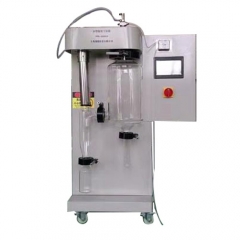
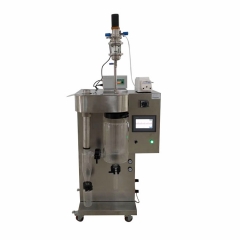
High quality 1.5L scale lab spray dryer equipment
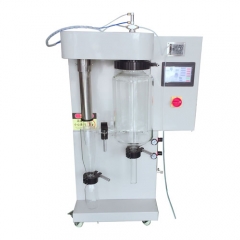
Lab scale spray dryer is suitable for the production of in universities, research institutes and food and pharmaceutical chemical enterprises.
A spray drying application case involving high-viscosity natural ingredients demonstrates that, through proper formulation adjustments and advanced drying technology, high-sugar and high-solid materials such as honey can be successfully transformed into powders with excellent storage stability, easy transportation, and good flowability.
For many food ingredient manufacturers, converting natural concentrated liquids into powder form has always been a challenging process. Honey, concentrated fruit juices, plant extracts, and various sugar-based syrups offer rich nutritional value and broad application possibilities. However, due to their high sugar content and naturally high viscosity, these materials often encounter challenges during spray drying, including wall sticking, low powder recovery rates, and poor powder flowability. How to achieve stable and efficient powder production while maintaining the original characteristics of the product has become a key focus for many manufacturers.
Unlike ordinary liquid materials, high-viscosity ingredients require careful consideration of their physical properties before entering a spray drying system.
Honey contains a high amount of natural sugars. During rapid moisture evaporation, these sugars can easily become sticky and create challenges for the drying process. If process parameters are not properly controlled, the material may adhere to the inner wall of the drying chamber, affecting continuous operation and reducing final product quality.
Therefore, when processing high-viscosity materials such as honey, simply increasing the drying temperature is not an effective solution. Proper material pre-treatment, formulation adjustment, and precise equipment control are equally important.
In this honey-based drying project, the technical team introduced an appropriate amount of maltodextrin as a carrier material before the drying process according to the characteristics of the raw material.
Maltodextrin plays an important role in spray drying high-sugar materials by:
By optimizing the ratio between honey and maltodextrin, combined with adjustments to inlet temperature, outlet temperature, feeding rate, and atomization parameters, the spray drying system successfully transformed the high-viscosity liquid into a fine and uniform powder.
This process is not only suitable for honey powder production but is also widely used for natural sweeteners, plant concentrates, fruit juice powders, and other high-solid food ingredients.
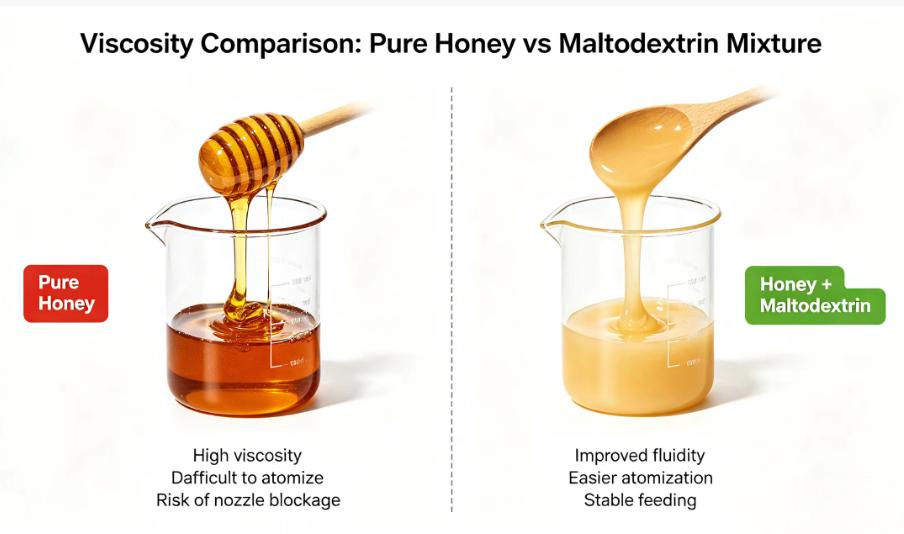
For high-viscosity materials, the design and configuration of a spray dryer directly influence the final drying performance.
Modern spray drying systems use high-efficiency atomization technology to break liquid materials into thousands of tiny droplets. These droplets come into full contact with hot air, allowing rapid moisture evaporation within a short period of time.
Due to the small droplet size and short drying residence time, spray drying can achieve high drying efficiency while minimizing the impact of prolonged heat exposure on product characteristics.
For materials that tend to stick, spray dryer design features such as optimized hot air distribution, efficient cyclone separation systems, and easy-to-clean structures are essential to ensure long-term stable operation.
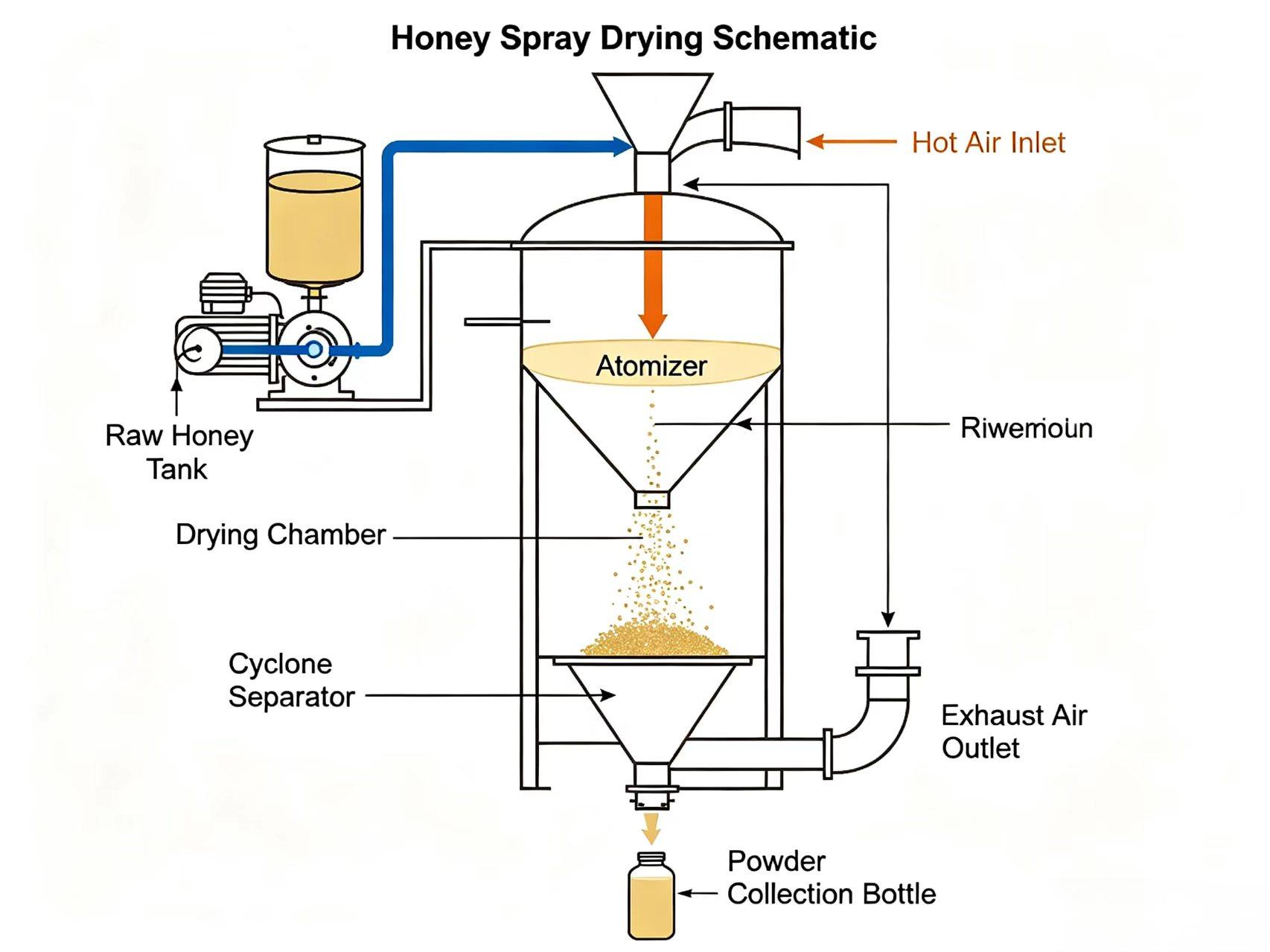
Honey spray drying is just one typical example of high-viscosity material processing. In recent years, as consumer demand grows for natural foods, functional ingredients, and convenient powdered products, more manufacturers have begun exploring liquid-to-powder processing technologies.
Spray drying technology is widely applied in the production of:
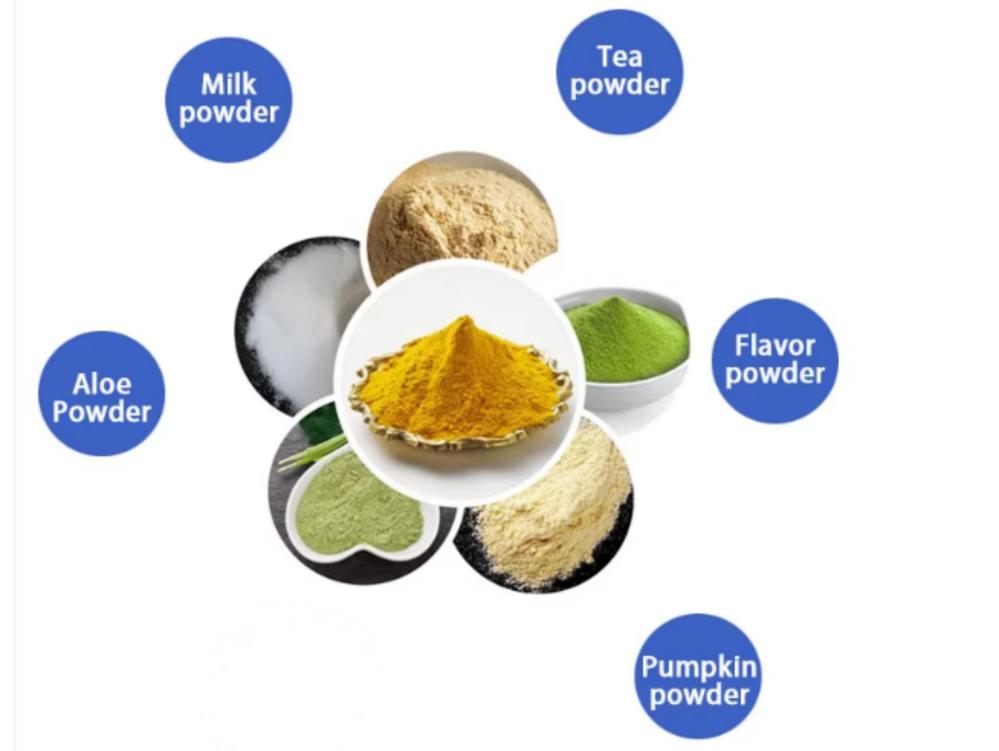
Through powder processing, these products can achieve longer shelf life, easier transportation, and broader application opportunities.
With years of experience in laboratory-scale and pilot-scale drying equipment development, OLLITAL provides customized spray drying solutions based on different material characteristics and production requirements.
For high-viscosity materials such as honey and concentrated liquids, successful spray drying depends not only on the equipment itself but also on comprehensive process optimization, including formulation adjustment, parameter testing, and equipment selection.
From laboratory research and development to large-scale production applications, OLLITAL is committed to helping customers establish more stable and efficient powder production processes while providing reliable drying technology support for ingredient manufacturers worldwide.



 Интернет Сервис
 +86 15960821529
 kevin@ollital.comkevinollital@gmail.com
 +86 15960821529
 +8615960821529


